The coming of the Lord
The Watchtower has a unique doctrine among the churches of Christendom when it comes to the end times. Today they claim that Christ’s predicted return happened in 1914 and that it was an invisible event. But during Charles Russell’s day, he claimed that return of Christ had occurred invisibly in 1874. He arrived at this date through a complex calculation of many Bible events and prophecies that also included a starting point (607 BCE), which no one else uses. Charles Russell was not the first to claim that Christ had returned “invisibly.” In this he was influenced by the Adventist movement that had begun with William Miller in 1831. Many people were interested in the topic of the end times and some developed biblical chronologies that attempted to put a date on Christ’s return. After a great disappointment in Oct 22, 1844 when an expected visible return of Christ failed to materialize, Miller changed his belief that Christ’s return would actually be invisible. Charles Russell was influenced by the Adventist movement in other doctrines as well, such as denying the immortality of the soul, hell fire, and the Trinity.
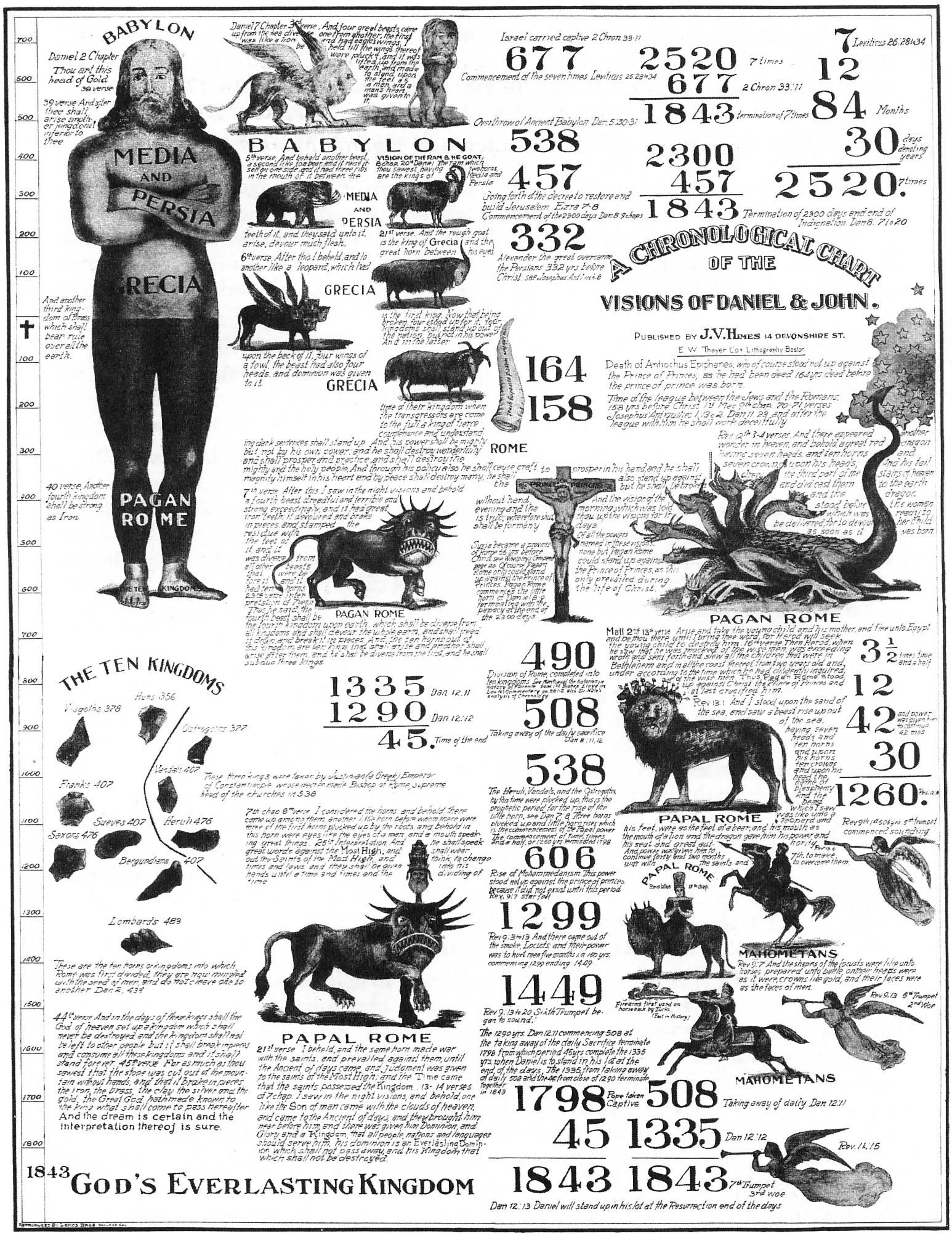
Later on, other Adventists believed and expected Christ’s return to occur visibly in 1873, but again were disappointed.
Resources related to the Adventist movement and the Millerite movement.
In the second edition of the Zion’s Watch Tower, (Aug 1879) Russell reveals his view of the parousia, if it is to be visible or not, and which Greek words are used to describe this event.
…but the error under which the church in general is laboring, is that of supposing that presence implies sight — manifestation — appearance. In the Greek, however, other words are used to express revelation, appearing and manifestation, viz: phaneroo — rendered shall appear in “when He shall appear, &c.,” — and apokalupsis — rendered, shall be revealed — `2 Thess. 1:7`. “When the Lord Jesus shall be revealed.” Zion’s Watch Tower, August 1879
Russell makes a distinction between parousia (presence), which he defines as being invisible and two other Greek words he thinks indicate a visible aspect to Christ’s return: phaneroo and apokalupsis. He doesn’t tell the reader that the words which “express revelation, appearing and manifestation” actually occur in the very same passages that speak about the “parousia”. Russell seems to see each Greek word as describing a different stage of Christ’s return. He actually missed a few more that are also used: erchomai (coming), orao (see), epiphania (appearance), and phaino (appear). We will discuss all of these words below.
Zion’s Watch Tower articles in which Russell has extended discussions on the Second Coming of Christ: August, 1879, September 1 & 15, 1898, February 15, 1902, March 15, 1902, August 15, 1914.
Testing Russell’s chronological calculations can get complex. I believe there is a conceptually simpler approach to testing this central doctrine of the Watchtower. And that is to test if the teaching that Christ would return invisibly is taught in scripture. The reason this is a simpler method is because IF it can be shown that Christ would return invisibly THEN it certainly is possible that he returned in 1914, or even at an earlier or a later date. However, IF it can be shown that the Bible teaches a visible return of Christ, then 1914 is a year that has no importance for biblical eschatology. This is because no one claimed to have seen Christ return in that year. So, what follows will try to test the assertion that the return of Christ is to be a visible event, not invisible. While it may not appear to be simpler than checking the chronological calculations because it will involve looking at a lot of verses as well, it is conceptually simpler: is the parousia supposed to be visible or invisible?
The Watchtower gives the impression that there is only one Greek word that is important when considering the topic of Christ’s return (or “presence” as they like to say), namely “parousia.” The table below will show that there are many Greek terms that were used by Bible writers when writing about and describing His return. Greek dictionaries mention 2 definitions for the word “parousia”, but the NWT consistently uses only one of those definitions, namely, “presence”. In the NWT (1984) Appendix 5B on the topic of the “Parousia” they do discuss 2 other Greek words, namely “pareimi” and “eleusis”. This is unfortunate because the average JW will think that they are doing a deeper study into related Greek terms that refer to Christ’s parousia, when in reality, these words are never used in relation to His future return at all! Thus that appendix sadly falls short in illuminating the reader of additional synonyms and descriptions used in the NT for Christ’s return. By focusing on unrelated terms it succeeds in misdirecting the reader in unfruitful directions to avoid any possible conclusions of a visible return. This is another example of the WT Society giving people a “guided tour” of the Bible, pointing out what they want them to look at, while carefully avoiding what they don’t want them to see.
How does Greek express invisibility?
But let’s first ask the question: Does the Greek language even have the vocabulary to discuss the concept of invisibility? If they had no vocabulary to describe it then we would have to infer it indirectly.
Well, we can confidently say that the Greek language does have the vocabulary to express invisibility. And in multiple ways. So, if the writers of the NT had needed to teach an invisible return of Christ, they had plenty of words at their disposal. At least 13 ways of describing something as invisible include:
- unseen, or that which can not be seen, e.g. invisible. (ἀόρατος = aoratos G517)
- Romans 1:20 (NASB) For since the creation of the world His invisible (aoratos = ἀόρατος) attributes, His eternal power and divine nature, have been clearly seen, being understood through what has been made, so that they are without excuse.
- Colossians 1:15-16 (NASB) He is the image of the invisible (aoratos = ἀόρατος) God, the firstborn of all creation. For by Him all things were created, both in the heavens and on earth, visible and invisible (aoratos = ἀόρατος), whether thrones or dominions or rulers or authorities—all things have been created through Him and for Him.
- 1 Timothy 1:17 (NASB) Now to the King eternal, immortal, invisible (aoratos = ἀόρατος), the only God, be honor and glory forever and ever. Amen.
- Hebrews 11:27 (NASB) By faith he left Egypt, not fearing the wrath of the king; for he endured, as seeing Him who is unseen (aoratos = ἀόρατος).
- taken out of sight, made invisible. (ἄφαντος = aphantos G855)
- Luke 24:31 (NASB) Then their eyes were opened and they recognized Him; and He vanished (aphantos = ἄφαντος) from their sight (literally: from them).
- disappearance, i.e. (figuratively) abrogation:—vanish away. (ἀφανισμός = aphanismós G853)
- James 4:14 (NASB) Yet you do not know what your life will be like tomorrow. You are just a vapor that appears for a little while and then vanishes (aphanismós = ἀφανισμός) away.
- not manifest, indistinct, uncertain, obscure. (ἄδηλος = adēlos G82)
- Luke 11:44 (NASB) “Woe to you! For you are like concealed (adēlos = ἄδηλος) tombs, and the people who walk over them are unaware of it.”
- secret, hidden, secrets, things, inwardly. (κρυπτός = kruptos G2927)
- Luke 12:2 (NASB) But there is nothing covered up (συγκαλύπτω) that will not be revealed (ἀποκαλύπτω), and hidden (kruptos = κρυπτός) that will not be known (γινώσκω).
- secret; by implication, treasured: hid, kept secret. (ἀπόκρυφος = apokruphos G614)
- Mark 4:22 (NASB) “For nothing is hidden (κρυπτός), except to be revealed (φανερόω); nor has anything been secret (apokruphos = ἀπόκρυφος), but that it would come to light (φανερός).
- to cover up on all sides. (συγκαλύπτω = sugkalupto G4780)
- Luke 12:2 (NASB) But there is nothing covered up (sugkalupto = συγκαλύπτω) that will not be revealed (ἀποκαλύπτω), and hidden (κρυπτός) that will not be known (γινώσκω).
- seized, retained. (κρατέω = krateo G2902)
- Luke 24:16 (NASB) But their eyes were prevented (krateo = κρατέω) from recognizing Him.
- not seen (οὐ βλέπω or μή βλέπω = ou blepo or me blepo G991)
- Romans 8:25 (NASB) But if we hope for what we do not see (ou blepo = οὐ βλέπω), with perseverance we wait eagerly for it.
- 2 Corinthians 4:18 (NASB) while we look not at the things which are seen, but at the things which are not seen (μή βλέπω = me blepo); for the things which are seen are temporal, but the things which are not seen (μή βλέπω = me blepo) are eternal.
- Hebrews 11:1 (NASB) Now faith is the assurance of things hoped for, the conviction of things not seen (οὐ βλέπω = ou blepo).
- no man has seen (οὐδείς ὁράω = oudeis orao 3708)
- John 1:18 (NASB) No one has seen (οὐδείς ὁράω = oudeis orao) God at any time; the only begotten God who is in the bosom of the Father, He has explained Him.
- not by sight (οὐ διά εἶδος = ou dia eidos 1491)
- 2 Corinthians 5:7 (NASB) for we walk by faith, not by sight (eidos = εἶδος)
- 1 Timothy 6:16 (NASB) who alone possesses immortality and dwells in unapproachable light, whom no man has seen or can see (eidos = εἶδος). To Him be honor and eternal dominion! Amen.
- no man seen (οὐδείς θεάομαι = oudeis theomai 2300)
- 1 John 4:12 (NASB) No one has seen (theomai = θεάομαι) God at any time; if we love one another, God abides in us, and His love is perfected in us.
- not made of visible things (μή γίνομαι ἐκ φαίνω = me ginomai ek phaínō 5316)
- Hebrews 11:3 (NASB) By faith we understand that the worlds were prepared by the word of God, so that what is seen was not made out of things which are visible (phaínō = φαινομένων).
Next, there are various ways to express invisibility by using one of two distinct words that mean not (οὐ or μή) plus a word that means see, sight, appear. Effectively, saying: “not visible” or “not seen”
Words which express visibility
When we examine the passages which refer to Christ’s return we find they use a variety of words to describe it. None of the passages use any words which have a definition of invisibility.
|
These words are used to describe Christ’s return.

These words will be discussed below. |
None of these words are used
with the topic of Christ’s return
The words which are discussed in the
NWT (1984) Appendix 5B |
The Significance
Words in a text are connected with each other in very many ways, including grammar and semantics. Some words in English have multiple meanings. For example, the word “bridge” can mean either a structure used to cross a river or a game of cards. In a text that contains the word “bridge” how can we know which meaning is being used? We look at other words that occur in the same context. If there are other words such as “drive,” “across,” “maximum weight,” etc. then we know its a structure used to cross a river. If the words “play,” “players,” “cards,” “take turns,” etc. are used, then we know its a game people play. So, the other words in a text will tell us which definition is being used in that text. It doesn’t take many words to clarify which definition is intended—one is enough. The words all fit together coherently like the pieces in a puzzle. When the passages that describe the “parousia” use multiple words that all share the concept of “visibility,” and no words occur that have the opposite meaning of “invisibility,” then we know for certain that the parousia will be a visible event and not an invisible one. All the evidence points in one direction and none points in the opposite direction.
The 2 words below, which ARE discussed in NWT (1984) Appendix 5B by the WTS, do NOT appear in verses which discuss the “parousia” of Christ.
| pareimi πάρειμι come/present (3918) | Occurs 24x: Mat 26:50; Luke 13:1; Joh 7:6; 11:28; Acts 10:21,33; 12:20; 17:6; 24:19; 1Co 5:3; 2Co 10:2,11; 11:9; 13:2,10; Gal 4:18,20; Col 1:6; Heb 12:11; 13:5 2Pe 1:9,12; Rev 17:8. This word never occurs with the topic of the “parousia”. |
| eleuseōs ἔλευσις coming (synonym of ἔρχομαι erchomai) (1660) | Occurs 1x: Acts 7:52 (refers to first coming, not the second). This word never occurs with the topic of the “parousia”. |
The most likely reason these words are discussed is to give JWs the impression that the Organization has studied the original Greek text and understands everything of importance relating to the topic of the parousia. They want to create a false impression of having done enough research to really know what the original Greek means. “Trust us, we’ve done our due diligence and researched all you need to know. No need to do your own research.” In reality, they are giving the reader “a guided tour” of scripture. Why else, in a section whose topic is the word “parousia”, discuss words that never appear together with the topic of the “parousia” and ignore everything that repeatedly shouts “visibility” in the passages where “parousia” does occur?
Here are the words and passages that Appendix 5B should have discussed in relation to the Parousia of Christ. Why didn’t they?
| coming (or presence) παρουσία {par-oo-‘see-a} Strong’s: G3952; (NT: 24x) |
Matt 24:3,27,37,39; 1Co 15:23; 1 Thess 2:19; 3:13; 4:15; 5:23; 2Th 2:1,8,9; James 5:7,8; 2Pe 3:4; 1 John 2:28
(other passages: 1Co 16:17; 2Co 7:6,7; 10:10; Phil 2:12) “Recent archaeological discoveries have explained why the word received such general Christian use in the special sense. In Hellenistic Greek it was used for the arrival of a ruler at a place, as is evidenced by inscriptions in Egypt, Asia Minor, etc. Indeed, in an Epidaurus inscription of the 3rd century BC (Dittenberger, Sylloge (2) , Number 803, 34), “Parousia” is applied to a manifestation of Aesculapius. Consequently, the adoption by the Greek-speaking Christians of a word that already contained full regal and even Divine concepts was perfectly natural.” (The evidence is well summarized in Deissmann, Light from the Ancient East 3, 368-73, German edition, 281-87.) [From: International Standard Bible Encyclopedia q.v. PAROUSIA] |
16 verses about Christ’s future return |
| coming ἔρχομαι {'er-kho-ma-hee} Strong’s: G2064; (NT: 604x) |
2 John 1:7 Used in the endtimes discourse: Mat 24:27,30,42,44; 25:31; Mark 13:26; Luke 12:40; 21:27; Other: Mat 16:27,28; 23:39; Mat 26:64; Mark 8:38; 14:62; Luke 9:26; 13:35; Luke 18:8; John 14:3,18,28; Acts 1:11; 1Co 15:23; 1Th 5:2; 2Th 1:10; 2:3; Rev 1:7; 22:12 It is undisputed that this verb means “coming”; the NWT also translates it as “coming”. And it is because of this word that gets used repeatedly in connection with Christ’s return (his “parousia”) that lexicographers and translators have translated the word “parousia” as “coming” when it refers to Christ’s return and not as “presence.” This is most clearly seen in the verses that mention the “Son of Man” coming. Note: this word co-occurs with parousia in Mat 24:27. | 23 verses about Christ’s future return |
| The word “see” (the root word is: οραω ‘to see’) occurs
113 times in NT This verb is an irregular verb; thus the many very different forms below. The references below are a sample of the verses with the Greek word “see”; the references are not exhaustive. It has been translated in different ways: passive: appear, perceive, understand, recognize, experience, visit, come to see (Heb 13:23); transitive: see, observe, notice; intransitive: make sure, see to, take care. |
||
| see: (ὄψονται) opsontai | Matt 24:30; Mark 13:26; 14:62; Luke 21:27; 1 John 3:2 (Other occurences: Luke 24:34; Acts 1:3; Mat 28:10; Mark 16:7; Luke 1:11; 3:6; 22:43; John 16:16,17,19,22; 19:37; Acts 13:31; 16:9) |
5x |
| see: (ὄψεσθε) opsesthe | Mat 26:64; Mark 14:62 (Other occurences: Mat 27:24; 28:7,10; Mar 16:7; Luke 17:22; John 1:39,51; 16:16,17,19; Act 18:15; 20:25) |
2x |
| appear: (ὀφθήσεται) ophthesetai | Heb 9:28 (Other occurences in LXX: Gen 9:14; Exo 23:17; 34:23; Lev 9:4,6; 13:7,19; Num 23:21; Deu 16:16; 23:14; 1Sa 1:22; 2Ki 22:20; Psa 84:7; 102:16; Isa 40:5; 60:2; Jer 13:26) |
1x |
| see: (ὄψεται) opsetai | Rev 1:7 (Other occurences: Luk 3:6; Jhn 3:36; Heb 12:14) |
1x |
| appear: (ὤφθη) ophthe | Mat 17:3; Mrk 9:4 (Moses and Elijah appearing); Luke 1:11; 22:43; 24:34; Act 7:2,26; 7:30; 13:31; 16:9; 1Co 15:5-8; 1Ti 3:16; Rev 11:19; 12:1,3 | 0x |
| appeared: (ὀφθέντες, ὀπτάνομαι, ὀφθείς) ophthentes, optanomai, ophtheis | Luke 9:31; Act 1:3; 9:17; 26:16 | 0x |
| see: (ἑωράκαμεν) et al, eorakamen | John 3:11,32; 6:36,46; John 8:57; 9:37; 14:9; John 20:18,25,29; 1Jo 1:1-3 | 0x |
| appearance; splendour (ἐπιφάνεια) (epiphaneia) {e-pi-‘fa-ni-ah} Strong’s: G2015 |
2Th 2:8; 1Ti 6:14; 2Ti 1:10; 4:1,8; Titus 2:11,13 The word was used like Parousia in Hellenistic Greek to denote the ceremonial arrival of rulers; compare Deissmann, as above. [From: International Standard Bible Encyclopedia] Note: this word co-occurs with parousia in 2Th 2:8 |
6x |
| appear; reveal (φαίνω) {'phaí-nō} Strong’s: G5316 |
Mat 24:27,30; Col 3:4; 2Ti 1:10; 1Pe 1:20; 5:4; 1Jo 3:2 (other passages: Mark 4:22; Luke 8:17; John 1:5,31; 3:21; 5:35; 9:3; Rom 2:28; 1Co 3:13; 14:25; 2Co 4:10-11; Gal 5:19; 1Ti 3:16; 4:15; Rev 3:18) | 6x |
| revealed (φανερόω) {phan-er-‘o-o} Strong’s: G5319 |
1 John 2:28 (parousia and phaneroo!); compare with Mark 16:12,14; John 21:1,14;
2Co 5:10; Col 3:4; 1Pe 5:4; (Other passages: Mark 4:22; 2Ti 1:10; Heb 9:26; 1Pe 1:20; Rev 15:4) Note: this word co-occurs with “parousia” in 1Jn 2:28. In the Zion’s Watch Tower of Sept 1 & 15, 1898 Russell lists 13 out of 16 verses which contain the word “parousia” and omits 1Jn 2:28! The only place CTR ever references 1 John 2:28 is in ZWT Aug 15, 1894 but with no commentary. |
4x |
| revealed, appearing (αποκαλυπτο) (apocalypse) | Luke 17:30; 1Co 1:7; Gal 3:23; 2Th 1:7; 2:8; 1Pe 1:7,13; 4:13 (Other occurences: John 12:38; 1Co 3:13; 2Th 2:3,6; 1Pe 1:5; 5:1) |
8x |
| Day of the Lord (ἡμέρα κυρίου) |
Luke 17:24; 1Co 1:8; 5:5; 2Co 1:14; Phil 1:6,10; 2:16; 1Th 5:2; 2Th 2:2; 2Pe 3:10 The term is used in various ways: day of Christ (4x); day of the Lord; in his day; day of our Lord Jesus Christ; day of our Lord Jesus; day of Christ Jesus |
9x |
| see (θεάομαι) | Acts 1:11; (Other occurences: Mat 6:1; 11:7; 22:11; 23:5; Mark 16:11,14; Luk 5:27; 7:24; 23:55; Joh 1:14,32,38; 4:35; Joh 6:5; 11:45; Act 8:18; 21:27; 22:9; Rom 15:24; 1Jo 1:1; 1Jo 4:12,14) |
1x |
| as a thief (κλέπτης) {kléptēs} | Mat 24:43; Luke 12:39; 1Th 5:2; 2Pe 3:10; Rev 3:3; 16:15 | 6x |
Three of the words above co-occur in the very same verses as the word “parousia”, namely: epiphania (2Th 2:8); phaino (Mat 24:27,30), and phaneroo (1Jn 2:28). When you look at other verses that use these three (epiphania, phaino, and phaneroo) you discover that they also use several additional words when speaking about the topic of Christ’s return, namely: apokalupto, oraoo and erchomai.
All of these Greek words are used for visible events. In the passages which discuss the return of Christ no words are ever used which mean “invisible” or “unseen.” The Watchtower organization knows this, otherwise it would call attention to any words which mean “invisible” immediately. Instead, they call the reader’s attention to words that never appear in passages that speak about the parousia. When the object of the verb is by nature immaterial and invisible, such as knowledge or understanding, then, of course, “see” is used figuratively. But when the object of the verb is a person, it is always a visible event. Instead of using the words “appear” or “reveal”, the NWT chose to use an older and less familiar word “manifest” that does not have an immediate visible definition in most people’s minds. This allows them to obscure the visible aspect as much as possible.
Other words to study which are synonyms for Christ’s second coming include: “day of wrath”, “last day”, or simply “day”.
Because the Watchtower Organization knows there are no words which have a definition of “invisible” that get used in connection to Christ’s return, they need to find something, somehow, and someway to make Christ’s return mean an “invisible return”. They do this by exploiting the fact that in many languages the same word can have different meanings in different contexts: sometimes it has a literal meaning, and sometimes figurative. When they see that a dictionary lists several meanings for a word they think that they can just pick any of those meanings and apply it anywhere they like. So they import a symbolic meaning and apply it to a word whose context is actually literal. They treat the dictionary like a menu in a restaurant.
Several comments to specific verses
When discussing Acts 1:11 JWs will claim that the fact that Christ rose and disappeared into the clouds means that his return was going to be invisible (see Acts 1:9-11). They try hard not to focus on the part that says: “This Jesus who was taken up from you into the sky will come in the same manner as you have seen him going into the sky” (NWT 2013). Other translations have “as you have watched him go”. Let’s try to use this sentence in another context: Elon Musk’s SpaceX program. Elon’s rockets return to earth and can be used again. If we heard a statement such as: “this rocket which went up into the sky will come in the same manner as you have seen it going into the sky” would we expect it to return invisibly? Of course not! Thus the most obvious interpretation of the same sentence is that a visible return should be expected, not an invisible one. This conclusion is supported and reinforced by the lack of any word in that sentence that has a meaning of invisibility. William Miller (and later Charles Russell) read into the verse his interpretation of an invisible return because he did not want to lose face and admit his prophecy had been wrong. He had motive to reinterpret the verse to his advantage because of his embarassing failed prophecy.
In discussing Rev 1:7 they claim that the phrase “every eye will see him” is meant figuratively because the word “eye” is used figuratively in Eph 1:18 where it is used as “the eyes of your heart.” They think that they can smuggle the figurative meaning from one context to another. But this is a completely arbitrary connecting of verses because they have nothing in common except for the word “eye.” And we can know that the word “eye” in the Ephesian passage is meant figuratively because the text says so: “eyes of your heart!” The passage in Rev 1:7 says “every eye will see him!”
Coming or Presence??
A common verb which occurs 26 times (in 25 verses) in connection with the return of Christ is the verb “come/coming” which is the Greek word “ἔρχομαι = erchomai.” (It occurs over 600 times in the NT.) The noun παρουσία or “parousia” can have 2 meanings: “come” and “presence” and it occurs 17 times in the context of Christ’s return. When a verb and a noun describe the same event their meanings will complement each other. The Watchtower admits that Greek dictionaries list more than one definition for the word “parousia.” So, where have they translated that word as “coming” or anything else other than their chosen first meaning, “presence?” Have they become Greek experts, or did they dismiss the second definition because they allowed “personal beliefs to color their renderings?” Reasoning from the Scriptures q.v. “Bible” p. 64. It seems that they treat a dictionary like a menu at a restaurant—pick whichever meaning suits you.
As will be readily seen from the list of verses below the Greek verb “erchomai” or “come/coming” is used interchangebly with, and more frequently for Christ’s return than the noun “parousia.” Indeed, they sometimes occur together in the very same sentence! This is particularly obvious when we look at the phrase “Son of Man” in connection with “erchomai” and “parousia.” Three verses use the noun “parousia” and “Son of Man” in the same sentence as in “the coming of the Son of Man”:
- Matthew 24:27 For just as the lightning comes (“erchomai”) from the east and flashes even to the west, so will the coming (“parousia”) of the Son of Man be.
- Matthew 24:37 For the coming (“parousia”) of the Son of Man will be just like the days of Noah.
- Matthew 24:39 and they did not understand until the flood came (“erchomai”) and took them all away; so will the coming (“parousia”) of the Son of Man be.
Note that it is only Matthew that uses the word “parousia” for Christ’s return even though Mark and Luke also report the very same discourse Christ gave to his disciples. Obviously then, there must be a synonym for it which adequately expresses the very same idea. This word is “erchomai” or “come/coming.”
Here are the 25 verses (using the NIV) which mention the future return of Christ and which use the Greek verb “erchomai” for come/coming (in red). Note also the 10x it is mentioned that his coming will be seen.
- Matthew 16:27 For the Son of Man is going to come in his Father’s glory with his angels, and then he will reward each person according to what he has done. I tell you the truth, some who are standing here will not taste death before they see the Son of Man coming in his kingdom.
- Matthew 23:39 For I tell you, you will not see me again until you say, ‘Blessed is he who comes in the name of the Lord.’
- Matthew 24:27 For as lightning that comes from the east is visible even in the west, so will be the coming (“parousia”) of the Son of Man.
- Matthew 24:30 At that time the sign of the Son of Man will appear in the sky, and all the nations of the earth will mourn. They will see the Son of Man coming on the clouds of the sky, with power and great glory.
- Matthew 24:44 So you also must be ready, because the Son of Man will come at an hour when you do not expect him.
- Matthew 25:31 When the Son of Man comes in his glory, and all the angels with him, he will sit on his throne in heavenly glory.
- Matthew 26:64 “Yes, it is as you say,” Jesus replied. “But I say to all of you: In the future you will see the Son of Man sitting at the right hand of the Mighty One and coming on the clouds of heaven.”
- Mark 8:38 If anyone is ashamed of me and my words in this adulterous and sinful generation, the Son of Man will be ashamed of him when he comes in his Father’s glory with the holy angels.
- Mark 13:26 At that time men will see the Son of Man coming in clouds with great power and glory.
- Mark 14:62 “I am,” said Jesus. “And you will see the Son of Man sitting at the right hand of the Mighty One and coming on the clouds of heaven.”
- Luke 9:26 If anyone is ashamed of me and my words, the Son of Man will be ashamed of him when he comes in his glory and in the glory of the Father and of the holy angels.
- Luke 12:40 You also must be ready, because the Son of Man will come at an hour when you do not expect him.”
- Luke 13:35 Look, your house is left to you desolate. I tell you, you will not see me again until you say, ‘Blessed is he who comes in the name of the Lord.’
- Luke 18:8 I tell you, he will see that they get justice, and quickly. However, when the Son of Man comes, will he find faith on the earth?”
- Luke 21:27 At that time they will see the Son of Man coming in a cloud with power and great glory.
- John 14:3 And if I go and prepare a place for you, I will come back and take you to be with me that you also may be where I am.
- John 14:18 I will not leave you as orphans; I will come to you.
- John 14:28 You heard me say, ‘I am going away and I am coming back to you.’ If you loved me, you would be glad that I am going to the Father, for the Father is greater than I.
- Acts 1:11 “Men of Galilee,” they said, “why do you stand here looking into the sky? This same Jesus, who has been taken from you into heaven, will come back in the same way you have seen him go into heaven.”
- 1 Corinthians 15:23 But each in his own turn: Christ, the firstfruits; then, when he comes, those who belong to him.
- 1 Thessalonians 5:2 for you know very well that the day of the Lord will come like a thief in the night.
- 2 Thessalonians 1:10 on the day he comes to be glorified in his holy people and to be marveled at among all those who have believed. This includes you, because you believed our testimony to you.
- 2 Thessalonians 2:3 Don’t let anyone deceive you in any way, for that day will not come until the rebellion occurs and the man of lawlessness is revealed, the man doomed to destruction.
- Revelation 1:7 Look, he is coming with the clouds, and every eye will see him, even those who pierced him; and all the peoples of the earth will mourn because of him. So shall it be! Amen.
- Revelation 22:12 Behold, I am coming soon! My reward is with me, and I will give to everyone according to what he has done.
It is precisely because the word “erchomai” is used so frequently for Christ’s return that translators recognize that the word “parousia” can have the same meaning, namely “coming.” One is a verb, the other a noun, but they are used in the very same context and they describe the very same event. Indeed, in the Gospels of Mark and Luke, the word “parousia” is never used to describe Christ’s return, but “erchomai” is used in all three Gospels. By translating “parousia” everywhere as “presence” the NWT tranlators have allowed “personal beliefs to color their renderings.”
Revelation is saturated with the concept of Christ’s return. Instead of using parousia, John employs other language, such as:
- "Behold, he is coming with the clouds" (Rev. 1:7)
- "I am coming quickly" (Rev. 3:11; 22:7, 12, 20)
- The vision of Christ’s victorious return in Rev. 19:11–21
The Greek verb John most commonly uses is ἔρχομαι (erchomai, "to come"), not parousia. Revelation also begins with the word ἀποκάλυψις (apokalypsis, "revelation/unveiling"), emphasizing the disclosure of Christ’s glory and future triumph rather than employing the technical term parousia.
Objections by JWs
A common rebuttal by JWs is to point to verses in which a particular word in question can have multiple meanings, or can have a literal and a figurative usage in different contexts. Thus they will point to a word in a verse which has a (legitimately) figurative meaning and then say, “Well, this word CAN mean X, therefore in that other verse it means X there too.” However, a reader cannot choose from multiple legitimate meanings of a word and assign any one of those meanings they like to any other passage where that word occurs! A word’s context determines which of several possible meanings any particular word has, not the reader.
Let me give an example that should make this clear. The topic of the parousia is one of the topics in which JW’s will use this approach. In the book Insight and the article on “Presence” the WTS goes to some length to establish that “presence” CAN be used in a figurative manner and for an invisible event. They then use this argument when discussing the word “eyes” in the context of Christ’s parousia. They say that because a word CAN legitimately be used in a non-literal way or for an invisible event they then implicitly assume that this allows them to interpret other passages as also being non-literal or figurative.
*** w69 8/15 p. 485 Christ’s Return—What Does It Mean for You? ***
But perhaps you are now asking, Then how are we to understand the words of Revelation 1:7: “Look! He is coming with the clouds, and every eye will see him”? The Bible speaks of two kinds of sight. Thus Jesus on one occasion said that his religious opposers were ‘blind guides leading the blind and that both would fall into a pit.’ (Matt. 15:14) Obviously Jesus did not mean that they were literally or physically blind, but that they were blind as to their understanding. So when you read that every eye will see Jesus you may be certain that, since the Word of God cannot contradict itself, what is referred to is figurative sight. (emphasis added)
To show why this method of interpretation is flawed, consider two examples that most people would immediately recognize as incorrect. First, I will interpret a figurative word as being literal; then I will interpret a literal word as being figurative.
Let’s begin with the figurative use of “eyes” in Eph 1:18. Every Bible student knows that “eyes” can be used either literally or figuratively. But suppose I am convinced (for some currently unknown theological reason) that this passage must refer to literal eyes. To justify this, I argue that since Scripture often speaks of literal eyes, this occurrence can be understood literally as well.
The problem with this approach is obvious. The immediate context—the closest and most important context—speaks of the “eyes of your heart.” This phrase indicates a figurative meaning because no one has ever found literal eyes on a human heart. Ever! So, words do not mean whatever we want them to mean. Their meaning is determined by the immediate context, not by any possible definition found elsewhere in Scripture or in a dictionary. Dictionaries are not like menus in a restaurant.
Now consider the reverse error. Some interpreters seem willing to do the opposite: turn a literal expression into a figurative one even when the text provides no indication that such a move is warranted. Imagine a liberal theologian who rejects miracles and argues that when Jesus healed the blind He did not restore their physical sight. Instead, because “eyes” can be used figuratively (as in Eph. 1:18), Jesus merely gave the blind greater insight and understanding. This interpretation preserves the theologian’s prior commitment against the supernatural.
But this is no more valid than the previous example. Importing a figurative meaning from one context into another that gives no indication of figurative language is just as mistaken as importing a literal meaning into a context that clearly requires a figurative one. The meaning of a word is determined by its own context, not by how it may be used somewhere else.
I just said that, for some interpreters, assigning a literal or figurative meaning to a passage seems remarkably flexible. There is a reason for this flexibility; it is not random. Just as a detective looks for motive when investigating a crime, we should look for motive when examining questionable interpretations.
In many cases, the motive can be theological, philosophical or even historical. Some interpreters have prior commitments that make the plain meaning of a text inconvenient or even unacceptable. As a result, they introduce symbolism where the context provides no indication that symbolism is present. This allows them to avoid conclusions that would otherwise conflict with their established beliefs.
When this happens, the interpreter is no longer allowing the text to speak for itself. Instead, the text is being made to conform to a pre-existing theological or philosophical system. The direction of authority has been reversed. Rather than deriving doctrine from Scripture, Scripture is being reinterpreted to protect pre-existing doctrine or philosophy.
What is especially important to recognize is that these figurative readings rest entirely upon the interpreter’s own authority. The text itself does not demand them. The immediate context does not support them. The original author’s intent does not require them. The interpretation is introduced from outside the text rather than drawn from within it.
This is the difference between exegesis and eisegesis. Exegesis seeks to discover the meaning intended by the author through careful attention to language, context, grammar, and historical setting. Eisegesis, by contrast, imports ideas, assumptions, and preferences into the text. It reads meaning into Scripture rather than drawing meaning out of it.
Of course, all interpreters bring assumptions to a text. Complete neutrality is probably impossible. The crucial question is whether we are willing to let the text correct our assumptions when they are shown to be wrong. An interpretation that survives only by assigning words new meanings, importing symbolism without contextual justification, or ignoring the author’s obvious intent is not being guided by the text. It is being guided by the interpreter’s desire to obtain a particular conclusion.
The safest principle is therefore the simplest: let words mean what their context indicates they mean. If the context points to a figurative meaning, interpret them figuratively. If the context points to a literal meaning, interpret them literally. To do otherwise is to replace the authority of the text with the authority of the interpreter.
There are consequences to mistreating the biblical text in the manner just described. If a leader interprets a text by assigning meaning based on his own authority (changing any text that contradicts his teaching into a symbolic or figurative meaning) then he loses all right to criticize anyone else who also uses authority to interpret the Bible. For example, the Catholic Church has its supreme human authority, the infallible Pope. And it also claims that tradition is a basis for establishing doctrine. Both of these can take precedence over the Bible alone. Accepting the Pope’s authority for interpreting the Bible is no different than accepting the Governing Body’s authority for interpreting the Bible. The only difference is that you’ll end up with different doctrines. Now JW’s will criticize a Catholic for adhering to unbiblical doctrines but find it difficult to admit that their doctrines are based on human interpretation, by an authority that admits they are neither inspired nor infallible. At least a Catholic can put their trust in an infallible Pope.
