1919
The WTS claims that Jesus selected them in 1919 because they were the only ones who were faithfully representing him. But what did the Organization actually teach and believe in 1919? All of the points below were either taught or accepted in 1919, yet are grounds for disfellowshipping today.
- Blood transfusions were acceptable. The first statement against blood transfusions was made on Sept 1, 1944. Then, on WT Jan 15, 1961 accepting a blood transfusion was deemed a disfellowshipping rule.
- Celebrating holidays was acceptable.
- Celebrating birthdays was acceptable.
- The cross was used as a symbol in worship until Oct 15, 1931.
- Time prophecies were made consistently: 1874, 1878, 1881, 1914, 1925.
- Jesus was worshipped for about 35 years after 1919. "Jehovah God commands all to worship Christ Jesus because Christ is the express image of his Father, Jehovah."—WT Nov 15, 1939, p. 339; "...whosoever would worship Him must also worship and bow down to Jehovah's Chief One in that capital organization, namely, Christ Jesus."—WT Oct 15, 1945, p. 313. Reversed in 1954: "...no distinct worship is to be rendered to Jesus Christ now glorified in heaven."—WT Jan 1, 1954, pp. 30-31
- All Christians go to heaven. There were no two classes of believers. No 144,000. Changed in 1935 when Rutherford announced at an assembly in Washington DC.
- Political neutrality was not enforced. In June 1, 1918, the WT urged Bible Students to observe a day of prayer for the war effort. "In accordance with the resolution of Congress of April 2nd, and with the proclamation of the President of the United States of May 11... it is suggested that the Lord's people everywhere make May 30th a day of prayer and supplication."—WT June 1, 1918, p. 174. "Subsequent comments lauded the United States and did not harmonize with the Christian position of neutrality."—1975 Yearbook of Jehovah's Witnesses.
- They were not called "Jehovah's Witnesses", they were known as "Bible Students." The name "Jehovah's Witnesses" was adopted in 1931, 12 years after the supposed appointment in 1919. "We always refuse to be called by any other name than that of our Head - Christians."—WT March 1883, p. 6
- Pyramidology and the use of Egyptian symbols. Russell taught that the The Great Pyramid of Giza was a divinely inspired witness of stone and that its measurements encoded Biblical chronology. In 1921, his followers built a pyramid-shaped tombstone near his grave site. It was built to mirror the proportions of the Great Pyramid. In 1928, Rutherford reversed this teaching. "We must therefore abandon the conclusion that the prophecy refers to the pyramid of Gizeh." "Satan put his knowledge in dead stone, which may be called Satan's Bible, and not God's stone witness."— WT Nov 15, 1928 "The Altar in Egypt" Part 1. "We now wonder why we ever believed in or devoted time to the study of the pyramid of Gizeh. Not only will we abandon such a study now, but we will ask God to forgive us."— WT Dec 1, 1928 "The Altar in Egypt" Part 2.
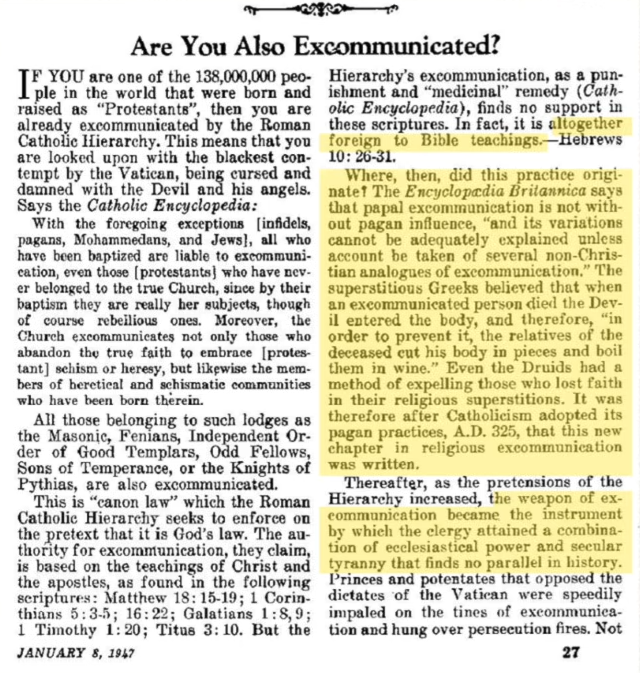
- There was no shunning policy. [See photocopy below] In Jan 8, 1947 the Society argued forcefully against the practice of religious excommunication, and called it "altogether foreign to Bible teachings." Then the article traced the whole practice to a pagan origin. They called it a tool of religious "tyranny". However, 5 years later they instituted their own version. "Those who are acquainted with the situation in the congregation should never say 'Hello' or 'Good-bye' to him... He is not welcome in our midst, we avoid him."—WT March 1, 1952 "Propriety of Disfellowshipping" p. 141
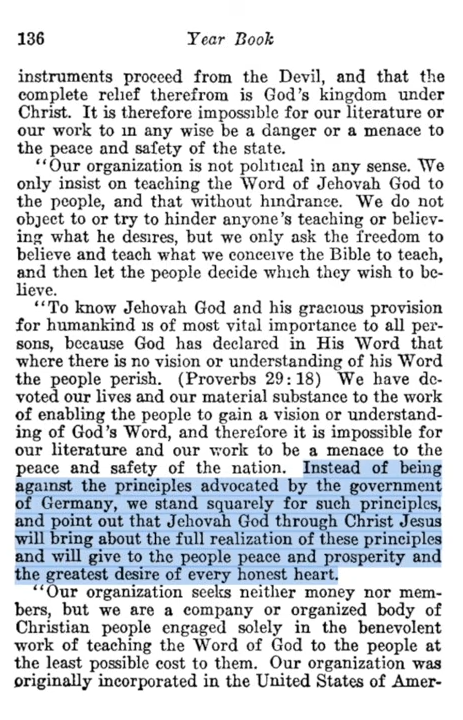
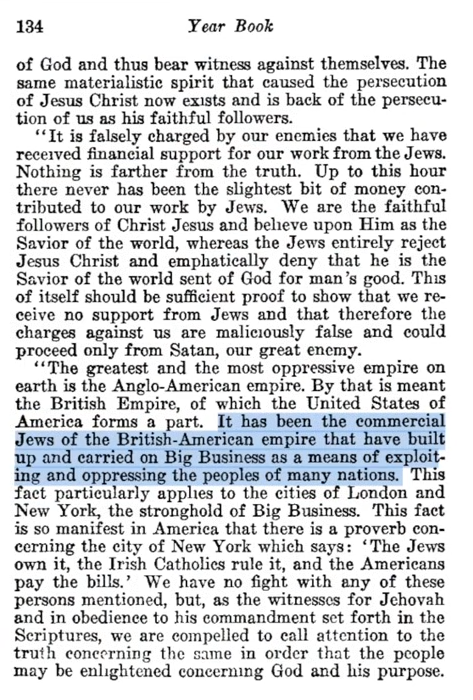
- Anti-Semitism and Racism were promoted. [See photocopies below] In 1933, Rutherford presented a document titled "The
Declaration of Facts" which he sent to the German Government. The 1934 Yearbook reprinted it.
In the publication "The Golden Age" in 1929 they stated: "It is generally believed that the curse which Noah pronounced upon Canaan was the origin of the Black race. Certain it is that when Noah said, 'Cursed be Canaan, a servant of servants he shall be unto his brethren,' he pictured the future of the Colored race. They have been and are a race of servants, but now in the dawn of the twentieth century, we are all coming to see this matter of service in its true light and to find that the only true joy in life is in serving others; not bossing them. There is no servant in the world as good as a good Colored servant, and the joy he gets from rendering faithful service is one of the purest joys there is in the world.
Footnotes
On blood transfusions -
Blood transfusions were both attempted and accomplished in the early 20th century, but the practice went through a massive, life-saving transformation during this period.
Before the 1900s, blood transfusions were attempted, but they were a medical lottery. Doctors knew little about why some patients survived while many others died violently from immune reactions or rapid blood clotting.
The early 20th century marked the turning point that made safe, routine blood transfusions possible:
1. The Discovery of Blood Groups (1900–1902) In 1901, Austrian physician Karl Landsteiner discovered the human ABO blood group system (initially identifying groups A, B, and O, with AB added shortly after). He proved that mixing blood from incompatible individuals caused red blood cells to clump together (agglutinate), explaining why past transfusions had so often been fatal. This discovery earned him the Nobel Prize and laid the scientific foundation for safe matching.
2. Cross-Matching and Practical Application (1907)
Building on Landsteiner’s work, American physician Reuben Ottenberg performed the first blood transfusion using pre-transfusion blood typing and cross-matching in 1907 to ensure the donor and recipient were compatible.
3. Overcoming Coagulation (1914)
A major hurdle in early 20th-century transfusions was that blood would rapidly clot once outside the body, meaning blood had to be transferred directly from donor to patient in a frantic, immediate window (often using complex surgical tubes and syringes).This changed in 1914, when the anticoagulant sodium citrate was successfully introduced. It prevented clotting, allowing blood to be stored and preserved for short periods.
4. Battlefield Implementation (World War I)
The immense casualties of World War I (1914–1918) supercharged the development of transfusion logistics. Military doctors like Lawrence Bruce Robertson and Oswald H. Robertson pioneered direct battlefield transfusions and established early blood-depot systems (effectively early blood banks) using citrate-glucose solutions to save wounded soldiers.
By the end of the 1910s and into the 1920s, blood transfusions had shifted from a desperate, high-risk experimental gamble into an established, life-saving medical procedure.
On Excommunication
"The Declaration of Facts"